
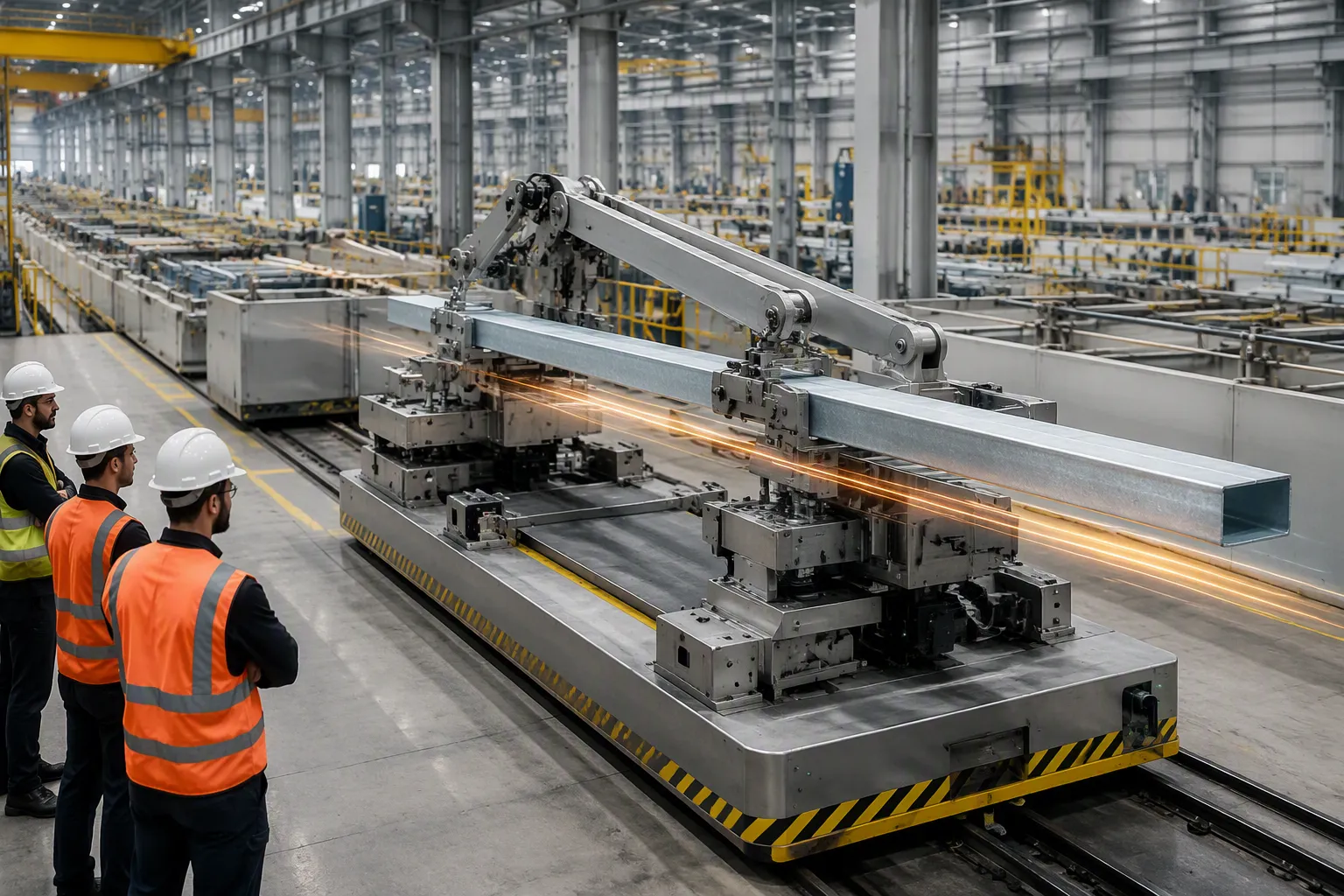
 Every stop-and-go cycle in your galvanizing line costs more than time. Manual crane operations create inconsistent transfer speeds, operator fatigue, and dangerous proximity to hot baths. These hidden expenses accumulate as rejects, wasted energy, and safety incidents.
What if one automated system could coordinate your furnace, bath, and cooling stations without human hands? An automatic transfer unit delivers this possibility. Its conveyor system, precision sensors, and heat recovery capabilities synchronize every movement.
You eliminate wait times. You remove human error. You gain measurable throughput increases from the first shift. The solution exists today—ready to transform your operation’s efficiency and safety profile.
Key Takeaways
- Automatic transfer units replace manual crane operations, eliminating stop-and-go delays and human errors.
- Precision sensors and anti-sway algorithms position loads within millimeters, boosting throughput from the first shift.
- The system removes workers from dangerous zones near molten zinc, preventing burns and injuries.
- Integrated cooling and heat recovery cut energy costs by reusing exhaust heat for preheating or heating.
- Modular design lets you retrofit the unit into existing lines during a single maintenance window.
Identifying Key Bottlenecks in Galvanizing Lines
Every galvanizing line has pinch points where production slows or stops. You know them well: the crane waiting to lift another load, the operator adjusting a hook by hand, the uneven rhythm between furnace discharge and bath immersion. These moments seem small individually. Together, they create a stop-and-go pattern that drains your throughput and inflates your costs.
Manual Handling Delays
Manual crane operations introduce unpredictable timing into your line. An operator must spot the load, position the hook, lift, travel, and lower—all while managing safety protocols near molten zinc. Fatigue sets in after hours of repetitive work. Reaction times slow. Each cycle takes longer than the last.
The financial impact of these delays is staggering. When your line stops unexpectedly, you lose more than production time. Industry data shows that each hour of lost galvanizing production costs over $150,000. A single unplanned shutdown can last anywhere from 8 to 24 hours. That means one incident could cost you anywhere from $1.2 million to $3.6 million. Manual handling errors—a misaligned hook, a dropped load, a late transfer—can trigger exactly these shutdowns.
Process Synchronization Gaps
Your furnace, bath, and cooling stations must work in perfect rhythm. When they fall out of sync, quality suffers. Consider what happens when a load arrives at the bath too early or too late. The temperature profile changes. Coating thickness varies. You produce rejects that customers will not accept.
Equipment failures amplify these synchronization problems. A sink roll bearing failure can halt your entire continuous galvanizing line for a full shift or longer. An air knife malfunction creates coating defects across every piece produced during that period. Your customers reject entire batches. You lose both material and credibility.
These gaps also waste energy. A furnace that idles while operators reposition loads burns fuel without producing value. A bath that holds workpieces too long consumes extra energy to maintain temperature. The waste compounds with every manual intervention.
An automatic transfer unit addresses these bottlenecks directly. It replaces unpredictable human timing with consistent, sensor-driven movement. You eliminate the wait times, the fatigue-driven errors, and the synchronization gaps that erode your profitability.
How the Automatic Transfer Unit Eliminates Bottlenecks
Core Components of the Automatic Transfer Unit
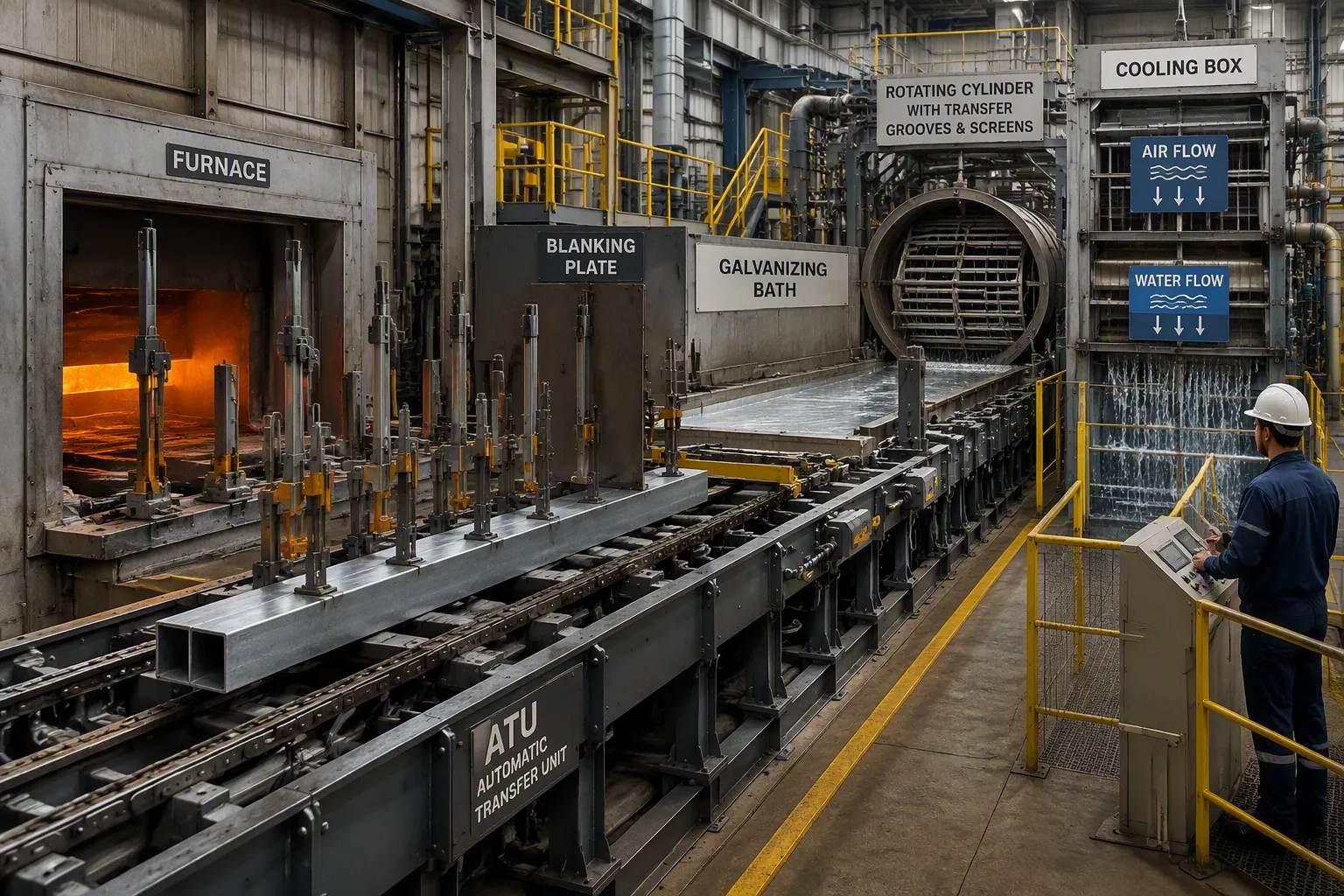
The automatic transfer unit replaces your manual handling delays with a system of precisely coordinated mechanical components. A robust steel base anchors the entire assembly to your plant floor. A conveyor belt runs along this base. Multiple positioning rods attach to the conveyor and secure workpieces during transit from furnace to bath and from bath to cooling station. The rods grip each load firmly. The positioning mechanism delivers a vertical stroke of 0.373 meters. This range accommodates different workpiece heights, from small brackets to long beams. The clamper stroke extends 0.48 meters. This provides secure grip across varying workpiece widths without damaging surfaces.
A cooling box sits downstream from the bath. It uses controlled air and water flow to cool parts evenly after galvanizing. Consistent cooling prevents warping and maintains coating integrity. A blanking plate sits between the stations. It prevents heat loss and maintains temperature stability during transfers. A rotating cylinder with transfer grooves and screens handles the final discharge from the cooling area. The grooves guide parts into the cooling zone at a controlled pace. The screens allow excess water to drain before the next process stage begins.
Each component eliminates a specific bottleneck from your line. The positioning rods remove the need for crane hooks and manual alignment. The cooling box prevents congestion at the cooling station by maintaining consistent cycle times. The blanking plate stops heat from escaping between transfers. This reduces energy waste and keeps your furnace operating near its design temperature. Together, these components create seamless material flow that your operators cannot achieve manually.
Precision Control and Material Flow
Sensors and intelligent algorithms drive the system’s timing and accuracy. Sensors monitor every position and movement along the line. The control system receives this data and adjusts speed, direction, and timing in real time. You no longer rely on operator judgment for these critical decisions. The system makes adjustments within milliseconds.
The accuracy advantage over manual crane operations is substantial. Consider how the two methods compare across key performance aspects:
| Operational Aspect | Manual Crane Operation | Intelligent Automated Crane Operation |
|---|---|---|
| Positioning Method | Operator judgment, repeated visual corrections | Sensor fusion with laser ranging, encoders, and RFID |
| Accuracy Level | Large errors, prone to misplacement | Millimeter-level precision (±5mm) without manual intervention |
| Load Stability | Significant sway, requires ~1/3 of cycle time to stabilize | Anti-sway algorithms reduce swing amplitude by 85-95% |
| Consistency | Highly variable based on operator skill | High repeatability and standardized execution |
A manual operator relies on eyesight and experience to position loads. This method produces large errors. Loads often arrive misaligned. Each correction takes time and extends the cycle. With the automatic system, sensors lock the position down to ±5 millimeters. The load arrives exactly where it needs to go on the first attempt. Load sway is another major source of delay. A swinging load requires about one-third of the total cycle time just to stabilize. The automatic unit reduces this completely. Its anti-sway algorithms cut swing amplitude by 85 to 95 percent.
The system achieves this through a multi-dimensional positioning approach. Laser ranging sensors measure distance to each target. Absolute encoders track trolley and hook positions continuously. RFID tags identify each workpiece and its processing stage. This data feeds into intelligent anti-sway algorithms. These algorithms actively suppress load swing during movement. The system navigates autonomously and recognizes targets without any manual corrections.
You eliminate the human error and repeated adjustments inherent in manual crane operations. The automatic transfer unit synchronizes furnace discharge, bath immersion, and cooling station delivery. Every load moves at the optimal speed. Each cycle follows the same predictable pattern. Your throughput increases from the first hour of operation.
Beyond Throughput: Safety, Cooling, and Heat Recovery
Reducing Workplace Injuries
Every operator in your galvanizing line faces real hazards each shift. They stand close to molten zinc baths that stay above 450°C. They guide heavy loads using chains and hooks. A single slip can cause severe burns or crushing injuries. Fatigue sets in after hours of repetitive manual work. Reaction times slow down. Risks climb higher with each passing hour.
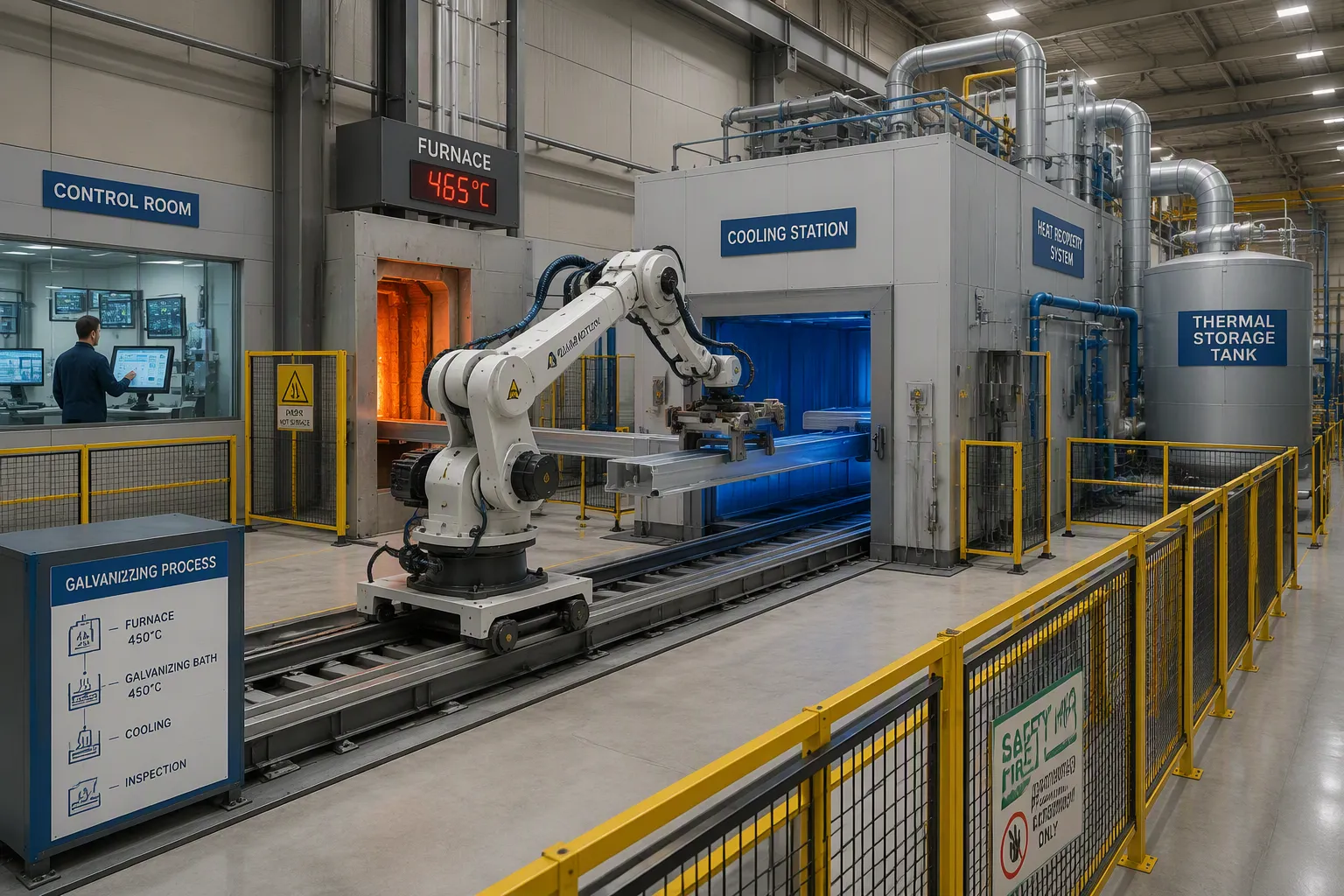
The automatic transfer unit removes workers from these dangerous zones. The system moves every workpiece from furnace to bath to cooling station without any human hands near the hot metal. Operators monitor the entire process from a safe distance using the touchscreen interface. They no longer stand beside the bath or under suspended loads. This change eliminates the primary causes of injury in galvanizing operations.
Ergonomic benefits go beyond immediate safety improvements. Manual crane work forces operators to twist, reach, and strain throughout every shift. These repeated motions create chronic back and shoulder injuries over time. The automatic system replaces this physical stress with seated monitoring and occasional supervision. Your workers leave each shift less tired and less exposed to long-term damage. Fewer injuries reduce your workers’ compensation costs and prevent lost production time.
Integrated Cooling and Energy Savings
Product quality depends on consistent cooling after galvanizing. The automatic transfer unit includes a dedicated cooling box for this purpose. The cooling box directs controlled air and water flow across each workpiece as it exits the bath. This even cooling prevents warping and keeps the coating thickness uniform across every part. The blanking plate sits between stations and prevents heat loss during transfers. It maintains a stable thermal profile throughout the entire processing cycle.
An optional waste heat recovery system turns the cooling process into an energy-saving feature. The system captures exhaust heat from the galvanizing line and redirects it for useful tasks. You can preheat cleaning fluids before they enter your process tanks. You can generate hot water for facility heating or other plant needs. Every unit of recovered heat lowers your total energy consumption. These savings build across every production shift you run.
You control the cooling and heat recovery system through the main touchscreen interface. Adjust parameters remotely from a computer or mobile device. Monitor energy recovery rates in real time. The system balances cooling quality with energy efficiency automatically. Your operational costs drop. Your product quality stays high.
Implementing the Automatic Transfer Unit in Your Plant
Integration with Existing Lines
You do not need to tear out your current galvanizing line to adopt this automation. The automatic transfer unit uses a modular design that adapts to varied plant layouts. Its base sections bolt together on your existing floor. You can position the conveyor, cooling box, and rotating cylinder to match your furnace and bath locations. This flexibility means you retrofit the system into your current workflow rather than redesigning your entire operation.
Installation causes minimal disruption. Your team prepares the foundation while your line continues running. The unit arrives pre-assembled in sections. Your crew connects these sections and wires the control system. Most installations complete within a planned maintenance window. You lose no additional production time beyond that scheduled downtime.
The control system integrates with your existing sensors and safety interlocks. You set parameters through the touchscreen interface. The unit communicates with your furnace controls to coordinate discharge timing. This synchronization happens automatically once you configure the initial settings.
Maintenance and Operator Training
Your maintenance team will find the system straightforward to service. The sensors and control components use standard industrial connections. You access most parts without special tools. The control system logs performance data continuously. You review this data remotely through a computer or mobile device. This remote access lets you spot developing issues before they cause downtime.
A planned maintenance program keeps the unit operating safely and reliably. Your program should include these elements:
- Maintenance and repair manuals that guide your personnel through each procedure.
- Checkoff lists for routine inspection and maintenance tasks.
- Schematic and logic diagrams that support troubleshooting and testing.
- Clear specifications for what to inspect, when to inspect it, and how to repair or replace components.
- A parts list that identifies necessary replacement items for each system.
Operators learn the system quickly. The touchscreen interface uses plain language prompts. Most operators master the core functions within a single shift. They monitor the process from a safe distance rather than standing beside the bath. Your training program focuses on reading the interface, responding to alerts, and understanding basic troubleshooting. The short learning curve means you gain throughput benefits almost immediately after installation.
You replace manual bottlenecks with a synchronized automated workflow. The automatic transfer unit coordinates every movement from furnace to bath to cooling station. Your throughput increases from the first shift. Workers stay safe away from hot metal and heavy loads. The cooling box and heat recovery system lower your energy bills. You gain higher productivity, better safety, and reduced costs together.
Do not wait for the next shutdown to reveal hidden expenses. Conduct a bottleneck audit on your current line today. Request a site evaluation for a pilot installation. Your operation deserves this reliable automation.
FAQ
How does the automatic transfer unit improve production speed?
It replaces manual crane operations with sensor-driven movement. Loads arrive at each station within ±5 millimeters. This eliminates wait times and repeated adjustments. Your line runs continuously without stop-and-go delays.
Can the system integrate with my existing galvanizing line?
Yes. The unit uses modular sections that bolt onto your current floor. It adapts to your furnace and bath locations. Installation completes within a planned maintenance window.
What training does my team need to operate the unit?
Most operators learn the touchscreen interface within one shift. The system uses plain language prompts. Your maintenance team handles standard industrial components without special tools.
How does the heat recovery system lower energy costs?
It captures exhaust heat from your galvanizing line. This recovered energy preheats cleaning fluids or provides hot water. You control parameters through the touchscreen or remotely.
Is the automatic transfer unit safe for workers?
It removes workers from dangerous zones near molten zinc baths. Operators monitor all movements from a safe distance. This eliminates the primary causes of burns and crushing injuries.
Post time: Sep-07-2026